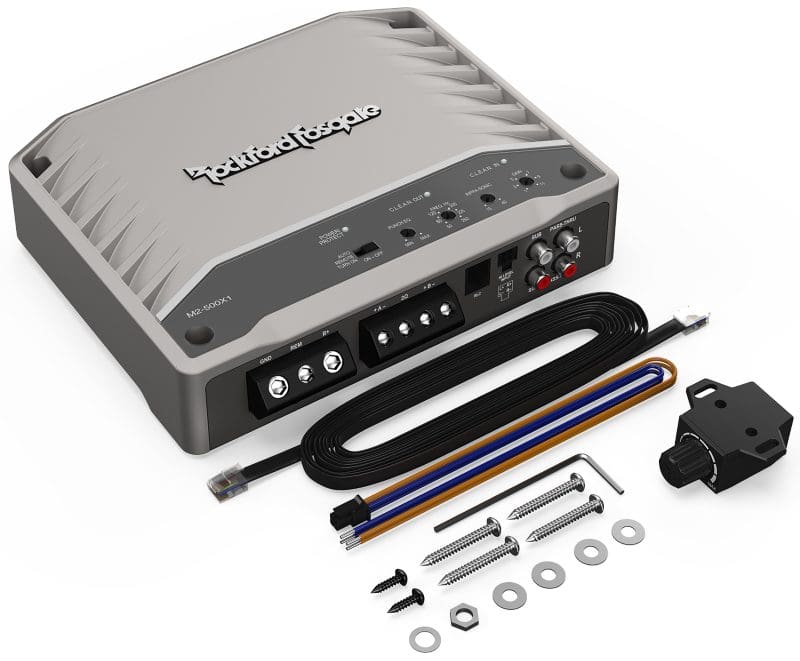
When it comes to marine entertainment systems, Rockford Fosgate speakers, subwoofers and amplifiers are among the best in the industry. If you’re searching for an amplifier to power the subwoofer system on your boat, the new M2-500X1 is a great choice. This 500-watt is efficient, includes all the features you could want and sounds great! Let’s check it out.
Features of the Rockford Fosgate M2-500X1
The M2 Series of amplifiers is based on the Prime Series of car audio amplifiers. The amplifiers have been upgraded with Element Ready features that improve their longevity in high-humidity applications. All the terminals are zinc nickel-plated brass so they won’t corrode. The heatsink, which measures 6.5 by 8.5 by 1.9 inches, has been powder-coated with a UV-resistant gray finish that will look great for years. The circuit board has a special conformal coating that prevents the tiny traces and components from oxidization that can affect performance. This amplifier and its two-, four- and five-channel brethren are serious about reliability and performance in marine applications.
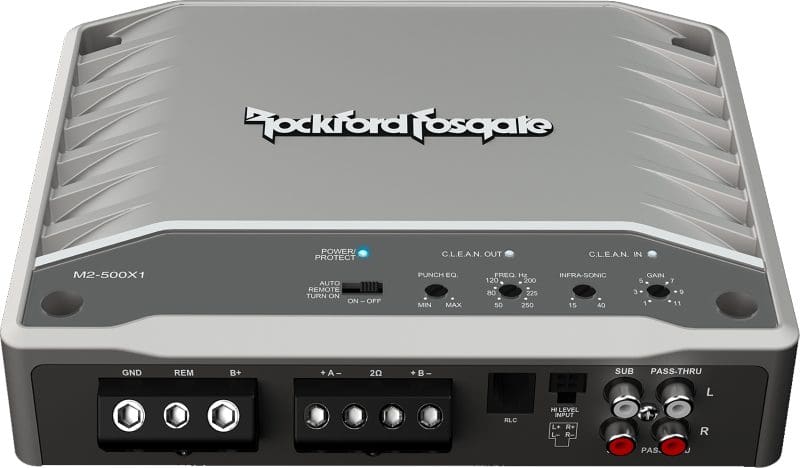
The M2-500X1 is a mono Class D amplifier designed to power subwoofers. The amp can produce a continuous 300 watts of power when driving a 4-ohm load. Power output jumps up to 500 watts when driving a 2-ohm load. Frequency response is specified as being 20 Hz to 250 Hz. The amp includes an adjustable high-pass infrasonic filter that can be set between 15 and 40 Hz, along with a low-pass filter that’s adjustable between 50 and 250 Hz. Both filters use -12 dB/octave Butterworth alignments. The amp also includes Rockford Fosgate’s Punch EQ circuit that allows for up to 18 dB of boost to be added at 45 Hz. If your subs didn’t hit hard before adding this amp, they will after! Finally, the amplifier includes an RLC remote level control to fine-tune the bass level quickly and easily right from the helm.
Your installer will appreciate that Rockford Fosgate has included their C.L.E.A.N. input and output clip LEDs to make it easy and fast to set the amp up. The amp has a set of RCA input jacks for low-level signals up to 4 volts. If your application requires it, speaker-level inputs on a pigtail will accept up to 12 Vrms of signal. The amp also has an auto-sensing turn-on feature that will activate it when it detects that a factory-style radio connected to the speaker-level inputs is turned on. Both inputs use a balanced differential design to optimize noise rejection for clean, clear sound.
A Pedigree of Car Audio Performance
With more than 50 years of car audio experience under their belts, the Rockford Fosgate team created the M2-500X1 with many of the technologies found in the Punch and Power Series models. In addition to the C.L.E.A.N. feature, the amp includes a high-efficiency MEHSA 4 high-mass heatsink to keep all the components running cool so they remain reliable. The NOMAD protection circuit monitors the amp for shorts or low-impedance loads to keep things safe. The M2-500X1 uses a loosely regulated power supply design called P.O.W.E.R. to maximize power production when the supply voltage increases. Finally, the amplifier and all the associated specifications comply with the ANSI/CTA-2006 standards for power rating. There are no “If Lightning Strikes” (ILS) numbers on Rockford Fosgate gear.
Upgrade Your Marine Audio System with Rockford Fosgate
If your boat needs great bass, drop by a local Rockford Fosgate retailer and check out the fantastic M2-500X1 500-watt mono Element Ready amplifier and the impressive M2 Series of 10- and 12-inch subwoofers. You can find a retailer near you using their dealer locator on their website. To learn more about the M2 Series of marine audio products, check out their Facebook page, Instagram feed and their amazing YouTube channel.
This article is written and produced by the team at www.BestCarAudio.com. Reproduction or use of any kind is prohibited without the express written permission of 1sixty8 media.
 As we move toward the end of our discussion of car audio electrical theory, we need to talk about capacitance and inductance and how the characteristics of those phenomena interact with AC and DC signals. There’s no doubt that these are advanced concepts, but even a basic understanding of how capacitors and inductors work is fundamental to a thorough understanding of
 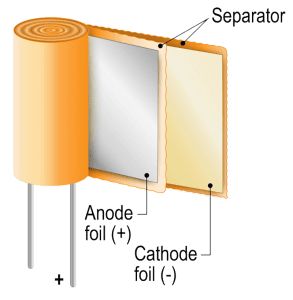 A capacitor is a two-terminal electronic component that stores energy. Capacitors are made of two metallic plates that are separated by an electrical insulator. When we apply a voltage to one terminal of the capacitor, the electrons on one plate will impose a force on the opposite plate to create an opposite charge. The result is that the plates have equal and opposite charges and thus, maintain an electric field. Because the plates in a capacitor are very close together, they can store a large amount of energy for their overall size.
 Capacitors are, at their most basic function, a device that stores a microscopic magnetic field between its plates. When we apply a DC voltage to a discharged capacitor, it appears as a short circuit for an instant as the magnetic and electric fields start to form between its plates. As the capacitor starts to store energy, it increases in effective resistance, and the amount of current flowing through the device is reduced. Once the capacitor has equalized with the supply voltage, almost no current passes through the device.
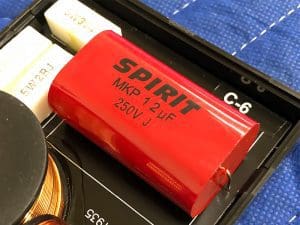 In alternating current circuits, capacitors take on an interesting phenomenon of “virtual resistance.” As we know, capacitors don’t like to change voltage, yet an AC signal is one that is defined as ever-changing. Depending on the relationship between the capacitor value and the frequency of the AC signal, some amount of the current is allowed to pass through the cap.
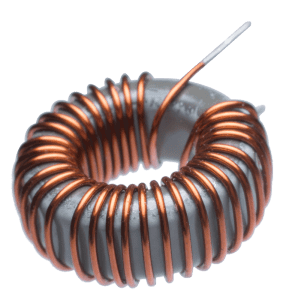 In the simplest of terms, an inductor is a coil of wire that creates a magnetic field based on the amount of current flowing through it. Many inductors feature iron cores to increase the intensity of the magnetic field. Where a capacitor resists changes in voltage, an inductor resists changes in current flow. We know from our previous article on magnetism that current flowing through a conductor creates a magnetic field around that conductor. If we wrap the conductor in a loop, the proximity of the loops to one another intensifies the magnetic field.
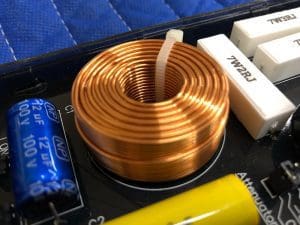 In most applications, we don’t want inductors in a 12V DC circuit because they resist changes in current flow. For a variable load such as an amplifier, a large amount of inductance in the supply wiring would result in an unstable supply voltage as the current requirements change.